

Phone / Whatsapp / Wechat
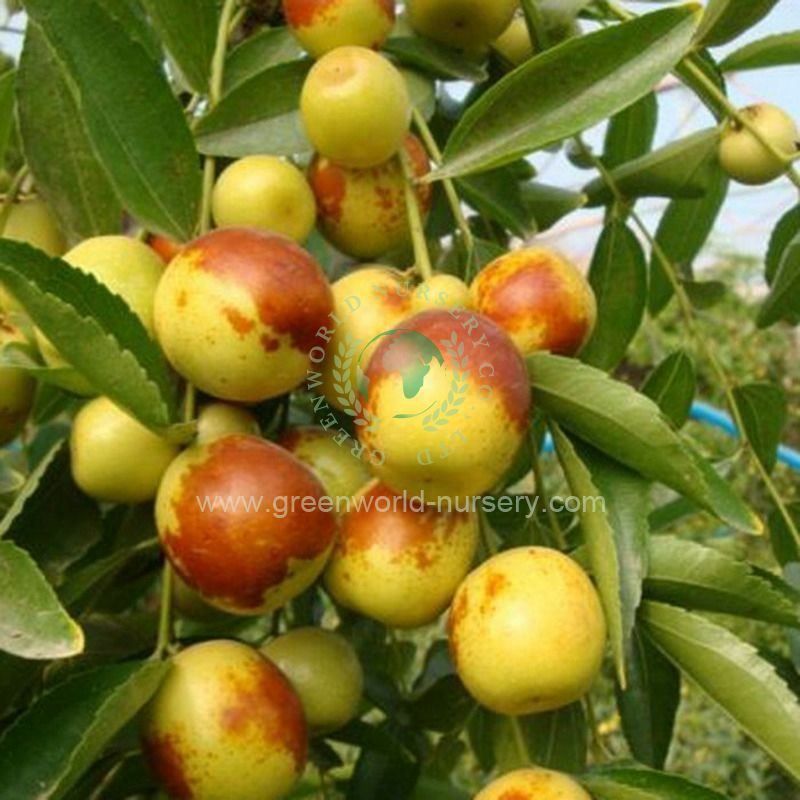


Ziziphus
Categories:
Fruit Trees
Ziziphus /ˈzɪzɪfəs/[3] is a genus of about 40 species of spiny shrubs and small trees in the buckthorn family, Rhamnaceae, distributed in the warm-temperate and subtropical regions throughout the world.

E-mail: export@greenworld-nursery.com
Whatsapp: 008613427573540
Keyword:
Ziziphus
Detail
Ziziphus /ˈzɪzɪfəs/[3] is a genus of about 40 species of spiny shrubs and small trees in the buckthorn family, Rhamnaceae, distributed in the warm-temperate and subtropical regions throughout the world. The leaves are alternate, entire, with three prominent basal veins, and 2–7 cm (0.79–2.76 in) long; some species are deciduous, others evergreen. The flowers are small, inconspicuous yellow-green. The fruit is an edible drupe, yellow-brown, red, or black, globose or oblong, 1–5 cm (0.39–1.97 in) long, often very sweet and sugary, reminiscent of a date in texture and flavour
Ziziphus species are used as food plants by the larvae of some Lepidoptera species including Bucculatrix zizyphella, which feeds exclusively on the genus, and Endoclita malabaricus.
Well known species includes Ziziphus jujuba (jujube), Ziziphus spina-christi from southwestern Asia, Ziziphus lotus from the Mediterranean region, and ber (Ziziphus mauritiana), which is found from western Africa to India. Ziziphus joazeiro grows in the Caatinga of Brazil. Ziziphus celata is listed as an endangered species in the United States.
The fruits are an important source for birds, which eat the whole fruit and regurgitate the seeds intact, expanding the seeds in the best conditions for germination (ornithochory). Secondly, seed dispersal is carried out by mammals or fishes. The fruit is energy-rich because of the large amount of sugar it contains. It is cultivated and eaten fresh, dry, and in jam. It is also added as a base in meals and in the manufacture of candy. The leaves can be either deciduous or evergreen depending on species, and are aromatic.
They are temperate or tropical plants, having a great range. They are most abundant where annual average temperatures are between 12 °C (54 °F) and 35 °C (95 °F) and minimum winter temperatures are not lower than −2 °C (28 °F). They prefer locations with a high temperature coupled with humidity. They require a deep soil, fresh, soft, siliceous-calcareous nature or limestone-clay-silica-clay and subsurface permeable, with pH between 5.5 and 7.8. In excessively sandy or clay soils which may be affected by standing water, the plants do not grow well. Many species are very sensitive to drought, and if the land is excessively dry and of calcareous nature, they may resent the lack of moisture. At the slightest drought, premature fruit drop is frequent. Ziziphus has several relict species living in temperate areas. These species can not endure the harsh winters of temperate continental climates.
The ecological requirements of the genus are mostly those of vigorous species with a great ability to propagate in conducive habitats. This genus is adapted mostly to high rainfall and humidity, but some species are deciduous, living in Mediterranean humid climate. The deciduous Ziziphus species lose all of their leaves for part of the year depending on variations in rainfall. In deciduous species in tropical, subtropical, and arid regions, leaf loss coincides with the dry season. They grow mostly in tropical forests but have also been found in stubbles, pastures, coastal ranges, tropical mountain areas, and wet to dry interior regions. The family is distributed throughout tropical and subtropical areas and in cloud forest.
The differences are ecological adaptations to different environments over a relatively dry-wet climate. Species in less humid environment are smaller or less robust, with less abundant and thinner foliage and have oleifera cells that produce trees with a more fragrant aroma
Previous Page
Next Page
Company Advantages
Quality & Experience
☑ Straight Trunk
☑ Well rooted & Well Formed Canopy
☑ Potted with Cocopeat
☑ More than 15 years Experience for Growing and Exporting Plants
Supply Ability & Plantation
☑ More Than 300000 Potted Plants Per Year
☑ More Than 100 Varieties of Plants Species
☑ More Than 205 Hectares Plantation, Still expanding.
Reasonable Price At All Times
☑ Rational and Competitive Price
☑ Maximum Value Added To Clients
Integrity & Responsibility
☑ Mutual Benefit & Win Win Solution
☑ Responsible For Any Lost Caused By Us
Frequently Asked Questions
WHAT IS YOUR QUALITY STANDARD AND AVAILABLE STOCK EACH YEAR?
WHAT IS THE PROCEDURE FOR EXPORTING THE PLANTS?
WHO WILL ARRANGE THE CONTAINER? AND HOW MUCH IS THE TRANSPORT?
WHAT IS YOUR PRICE TERM AND PAYMENT TERM?
WHAT KIND OF DOCUMENTS YOU PROVIDE FOR EXPORTING PLANTS?
WHAT IS THE DELIVERY TIME AFTER PLACING THE ORDER?
ARE YOU A TRADER OR PRODUCER FOR PLANTS?
WILL THE PLANTS DIE IN THE CONTAINER WITHOUT LIGHT AND WATER DURING LONG TRANSPORT?
WHICH SEA PORT WE USE TO EXPORT THE PLANTS?
WHAT KIND OF CONTAINER AND TEMPERATURE FOR EXPORTING THE PLANTS?
PLANTS CATERGORIES
Add:Address:
Gongchun Village, Mingcheng town, Gaoming district, Foshan City, Guangdong province
Phone / Whatsapp / Wechat:
SAF Coolest v1.3.1.2 设置面板 GAGSD-ZGYF-JQXZE-XFW
V1.3.1 SVG图标库请自行添加图标,用div包起来,并命名使用
General Manager : Tom Tse
Phone / WhatsApp / Wechat:
0086-13427573540
Sale: Jenny
Phone / WhatsApp / Wechat:
E-mail: